People were deeply moved by St. John the Forerunner’s warning of the coming judgment and wanted to know how to amend their lives. St. John’s answer was grounded in mercy and justice—the same command proclaimed by the prophet Micah, that we “do justice, love kindness, and walk humbly with God.”
John was not giving a detailed code of behavior for every circumstance, but rather revealing the heart of the law. Repentance meant a shift away from “each man for himself” to becoming one’s brother’s keeper. True turning to God always includes turning toward the neighbor, because love of God and love of neighbor cannot be separated.
In practical terms, this means that part of faithfulness to God is found in serving others. Just as our sins often make life harder for those around us, repentance produces the opposite effect: making another’s life a little lighter, even through small acts of mercy. These are the fruits worthy of repentance, the visible sign that one’s heart has truly turned toward God.
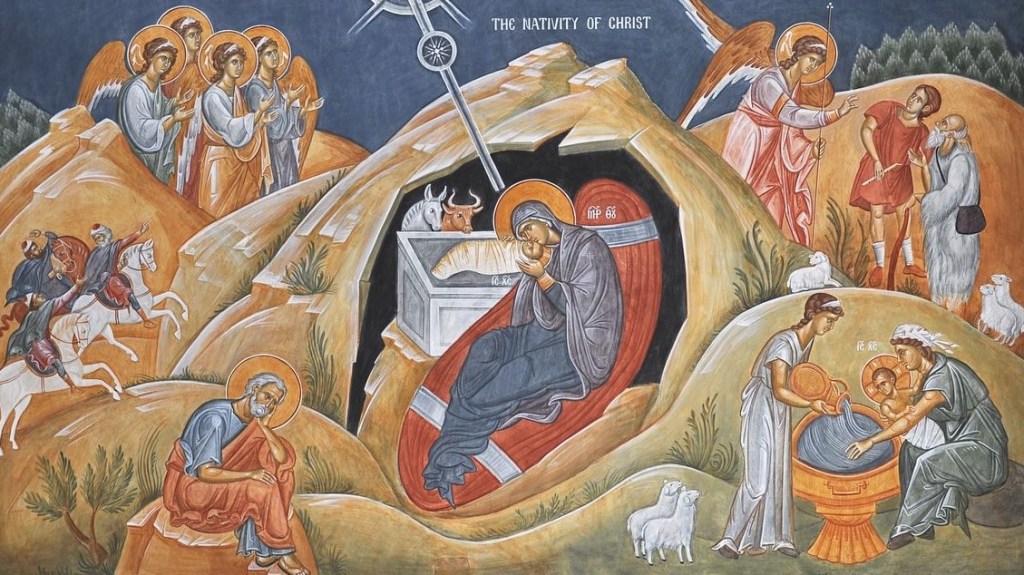
This is Saint Isaac the Syrian on the Feast of Christ Nativity: “This is the night of the most gentle one. Let no one be cruel. This is the night of the humble one. Let no one be proud. Now is the day of joy. Let us not revenge.” → [Watch Video]
One of my favorite Eastern Orthodox authors is Metropolitan Anthony Bloom. And my favorite book written by Metropolitan Anthony is “Living Prayer.” Unfortunately it’s not so easy to find copies of it anymore as, I believe, it is our of print. If you can’t find it, I’d recommend another of his books on prayer, “Beginning to Pray.”
“Living Prayer” is not a long book, but it just offers some beautiful insights into having a healthy — a living! — prayer life. One of the chapters includes a quote from St Ambrose of Optina concerning the Last Judgment. It’s a reminder about the importance of humility in our spiritual life. I remember when I first read this quote, it just gave me much hope and encouragement in my own spiritual life. Here’s Metropolitan Anthony, quoting from St Ambrose:
“Ambrose of Optina, one of the last Russian Staretz, said once that two categories of men will attain salvation: those who sin and are strong enough to repent, and those who are too weak even to repent truly, but are prepared, patiently, humbly and gratefully, to bear all the weight of the consequences of their sins; in their humility they are acceptable to God.”
What wonderful words to hold onto as we struggle with our own sins, particularly our habitual sins. Ultimately the thing that opens the floodgates of God’s mercy is that we embrace a humble heart.
Before and above all else, may we cultivate a spirit of humility. Anybody who can cultivate that spirit, anybody who can go through their lives with a humble heart, is capable of salvation and eternal joy.
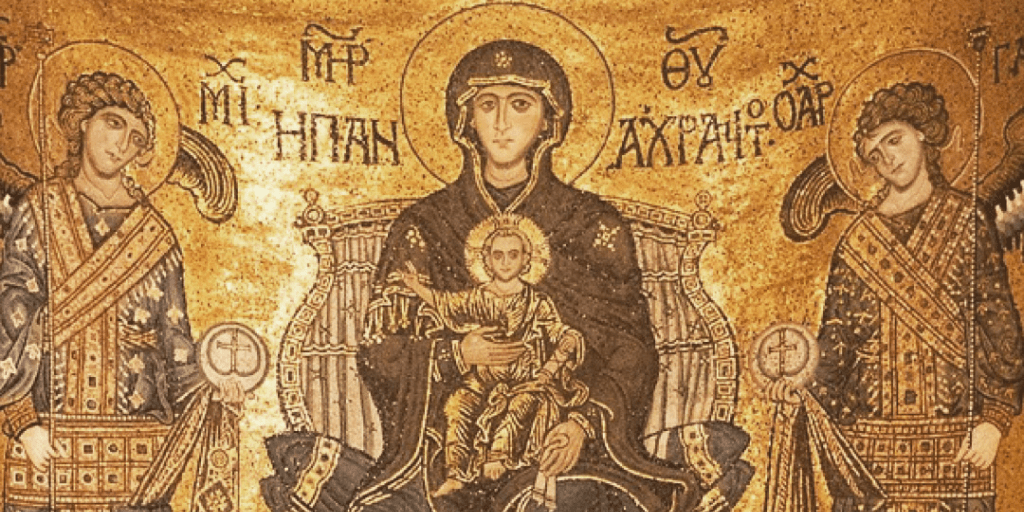
Here are some more quotes on Mary from Church Fathers throughout the centuries:
“I have been amazed that some are utterly in doubt as to whether or not the holy Virgin is able to be called the Mother of God. For if our Lord Jesus Christ is God, how should the holy Virgin who bore him not be the Mother of God?” (St Cyril of Alexandria, 5th century)
“Though still a virgin she carried a child in her womb, and the handmaid and work of his wisdom became the Mother of God.” (St Ephraim the Syrian, 4th century)
“The first thing which kindles ardor in learning is the greatness of the teacher. What is greater than the Mother of God? What more glorious than she whom Glory Itself chose?” (St Ambrose of Milan, 4th century)
“For Luke, in the inspired Gospel narratives, delivers a testimony not to Joseph only, but also to Mary, the Mother of God, and gives this account with reference to the very family and house of David.” (St Gregory the Wonderworker, 3rd century)
“And if the former (Eve) did disobey God, yet the latter (Mary) was persuaded to be obedient to God, in order that the Virgin Mary might become the advocate of the virgin Eve. And thus, as the human race fell into bondage to death by means of a virgin, so it is rescued by a virgin; virginal disobedience having been balanced in the opposite scale by virginal obedience.” (St Irenaeus of Lyons, 2nd century)
“Eve, who was a virgin, willingly brought forth the word of the serpent into the world. Mary, the Virgin, willingly brings forth the Word of God into the world.” (St Justin Martyr, 2nd century)
The ancient Christian Fathers with one voice honor Mary as the Virgin Mother of God, whose obedience to the will of the Father opens the doors of salvation for all. This understanding echoed through the centuries in Christianity, even in some most unexpected places. Consider the following:
“I firmly believe that Mary, according to the words of the Gospel, as a pure virgin brought forth for us the Son of God, and in childbirth and after childbirth forever remained a pure, intact virgin.” (Ulrich Zwingli)
“To this day we cannot enjoy the blessing brought to us in Christ without thinking at the same time of that which God gave as adornment and honor to Mary in willing her to be the mother of his only-begotten Son.” (John Calvin)
“She is rightly called not only the mother of the man, but also the Mother of God.” (Martin Luther)
Through the prayers of the Theotokos, may our Lord Jesus Christ have mercy on us.
If any man be devout and love God, let him enjoy this fair and radiant triumphal feast. If any man be a wise servant, let him rejoicing enter into the joy of his Lord. If any have labored long in fasting, let him now receive his recompense. If any have wrought from the first hour, let him today receive his just reward. If any have come at the third hour, let him with thankfulness keep the feast. If any have arrived at the sixth hour, let him have no misgivings; because he shall in nowise be deprived thereof. If any have delayed until the ninth hour, let him draw near, fearing nothing. If any have tarried even until the eleventh hour, let him, also, be not alarmed at his tardiness; for the Lord, who is jealous of his honor, will accept the last even as the first; He gives rest unto him who comes at the eleventh hour, even as unto him who has wrought from the first hour.
And He shows mercy upon the last, and cares for the first; and to the one He gives, and upon the other He bestows gifts. And He both accepts the deeds, and welcomes the intention, and honors the acts and praises the offering. Wherefore, enter you all into the joy of your Lord; and receive your reward, both the first, and likewise the second. You rich and poor together, hold high festival. You sober and you heedless, honor the day. Rejoice today, both you who have fasted and you who have disregarded the fast. The table is full-laden; feast ye all sumptuously. The calf is fatted; let no one go hungry away.
Enjoy ye all the feast of faith: Receive ye all the riches of loving-kindness. let no one bewail his poverty, for the universal kingdom has been revealed. Let no one weep for his iniquities, for pardon has shown forth from the grave. Let no one fear death, for the Savior’s death has set us free. He that was held prisoner of it has annihilated it. By descending into Hell, He made Hell captive. He embittered it when it tasted of His flesh. And Isaiah, foretelling this, did cry: Hell, said he, was embittered, when it encountered Thee in the lower regions. It was embittered, for it was abolished. It was embittered, for it was mocked. It was embittered, for it was slain. It was embittered, for it was overthrown. It was embittered, for it was fettered in chains. It took a body, and met God face to face. It took earth, and encountered Heaven. It took that which was seen, and fell upon the unseen.
O Death, where is your sting? O Hell, where is your victory? Christ is risen, and you are overthrown. Christ is risen, and the demons are fallen. Christ is risen, and the angels rejoice. Christ is risen, and life reigns. Christ is risen, and not one dead remains in the grave. For Christ, being risen from the dead, is become the first fruits of those who have fallen asleep. To Him be glory and dominion unto ages of ages. Amen.
About St. John Chrysostom:
St. John Chrysostom (“The Golden Tongue”) was born at Antioch in about the year 347 into the family of a military-commander, spent his early years studying under the finest philosophers and rhetoricians and was ordained a deacon in the year 381 by the bishop of Antioch Saint Meletios. In 386 St. John was ordained a priest by the bishop of Antioch, Flavian.
Over time, his fame as a holy preacher grew, and in the year 397 with the demise of Archbishop Nektarios of Constantinople—successor to Sainted Gregory the Theologian—Saint John Chrysostom was summoned from Antioch for to be the new Archbishop of Constantinople.
Exiled in 404 and after a long illness because of the exile, he was transferred to Pitius in Abkhazia where he received the Holy Eucharist, and said, “Glory to God for everything!”, falling asleep in the Lord on 14 September 407.
Today He Who hung the earth upon the waters is hung on the tree. The King of the angels is decked with a crown of thorns. He Who wraps the heavens in clouds is wrapped in the purple of mockery. He Who freed Adam in the Jordan is slapped on the face. The Bridegroom of the Church is affixed to the Cross with nails. The Son of the Virgin is pierced by a spear. We worship Your Passion, O Christ. We worship Your Passion, O Christ. We worship Your Passion, O Christ. Show us also Your glorious Resurrection.



 Eastern Orthodoxy