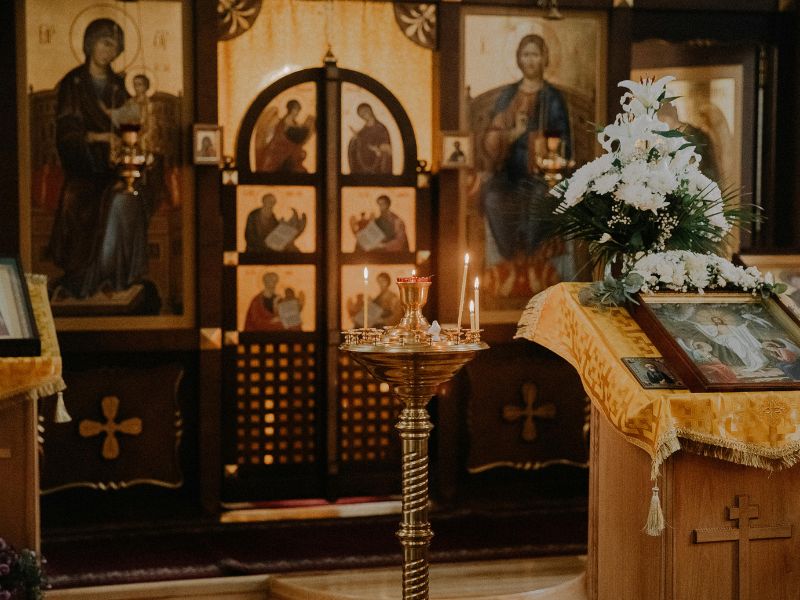
Unpacking the Prayer “Lord, Have Mercy”

Visit an Eastern Orthodox worship service, and you’ll see how much we love the prayer, “Lord, have mercy.” In this short phrase, we find everything we need in our prayers.
We call God “Lord.” This word may not carry the same weight for us in the modern world, but in biblical times, to call someone “Lord” was to acknowledge their authority over our lives. By addressing God as Lord, we are declaring our obedience and allegiance to Him as the one who is truly in charge.
Next, we ask for His mercy. Understanding the ancient meaning of this word deepens our prayer. In Hebrew, the word for mercy is hesed, which can also be translated as “steadfast love.” For example, in the Psalms, you might see “God’s mercy endures forever,” or in other translations, “God’s steadfast love endures forever.” Both phrases translate the same Hebrew word. To call upon God’s mercy, then, is to trust ourselves to His loving embrace.
In Greek, the word is eleos. There is only a one-letter difference between eleos (mercy) and eleon (olive oil). This connection is significant. In the Old Testament, olive oil was poured over the heads of kings, prophets, and priests during their anointing. This ritual symbolized that, by themselves, human beings are insufficient for these ministries, but through God’s wisdom and strength—His grace—they are able to fulfill their calling. Even today, in the Orthodox Church, we pray that God’s grace will “fill that which is lacking and heal that which is broken” during ordination.
Olive oil, then, becomes a symbol of God’s strength and wisdom. In the story of Noah, the dove returns with an olive branch, signaling that the floodwaters are receding and that God is offering humanity a new beginning—a chance for renewal. Olive oil was also used in the ancient world as a salve to heal wounds, protecting and cleansing them. This, too, reflects God’s mercy as His healing grace.
When we pray, “Lord, have mercy,” we are asking God for the most essential gifts: His strength and wisdom, His forgiveness, and His healing grace. All of these flow from His steadfast love for us, enabling us to embrace and live out the gift of salvation given to us by Jesus Christ, every day of our lives.
Echoes of Heaven

For first-time visitors to an Orthodox Church, one of the most striking aspects of the worship experience is the absence of musical instruments. This isn’t merely a stylistic choice; it’s a deliberate theological expression rooted in the history and beliefs of Eastern Orthodoxy.
The roots of Eastern Orthodoxy trace back to the earliest Christian communities, offering worship practices that have remained consistent for nearly two millennia. Historically, early Christians were influenced by Jewish synagogue practices, which had already moved away from instrumental accompaniment by the first century AD. The Early Christians associated instruments with pagan rituals and secular entertainment, leading them to favor a cappella singing as a way to distance themselves from these practices.
In Eastern Orthodoxy, the human voice is considered the perfect instrument. Created as we are in God’s image, our voices are seen as the purest form of musical expression. When Orthodox Christians sing, they are not merely performing music; they are offering their very breath as prayer. The voice, emerging from within the body, symbolizes prayer rising from the heart.
The term “Orthodox” itself is significant, with “doxa” meaning glory in Greek. This word carries two meanings: to praise and to make clearly known. The human voice is believed to be the most perfect way to offer God glory, as it allows for both praise in words and music and the proclamation of Christ’s Gospel through hymns and chanted prayers.
Orthodox worship aims to create an “icon of sound,” a window into heaven, not only through what is seen but also through what is heard. The unadorned human voice captures the essence of angelic worship. In a world increasingly dominated by electronic and produced sound, there is something refreshingly authentic about spaces where human voices alone fill the air.
Through psalms, hymns, and spiritual songs, Orthodox Christians offer praise to God and make His truth — that truth that sets us free — known to all who experience the timeless, angelic beauty of the Orthodox Christian liturgy.
The Holy Mystery of Matrimony
Too Big for Words – Part 7
In this message from our Holy Mysteries sermon series, we reflect on the Holy Mystery of Matrimony. In the Orthodox Tradition, a marriage is a sacred offering—brought into the church for God’s blessing, like Jesus blessing the marriage in Cana of Galilee by performing his first miracle there, turning water into wine.
The Anointing of the Sick
Too Big for Words – Part 6
In this sixth installment of my sermon series on the Holy Mysteries – the sacraments – he discussed the Mystery of Holy Unction. “Is any among you sick? Let him call for the elders of the assembly, and let them pray over him, anointing him with oil in the name of the Lord.” (James 5:14)