“Glory to God for All Things!”


An Akathist Prayer is sacred poetry, consisting of thirteen segments. The word “akathist” means “without sitting,” indicating that these prayers are meant to be recited standing up.

The earliest and best known Akathist is to the Mother of God. A contemporary Akathist that has captured the hearts of Orthodox faithful throughout the world is the Akathist of Thanksgiving, also known as “Glory to God for All Things” (St. John Chrysostom’s final words.

The Akathist of Thanksgiving is the 20th-century composition of a Russian Orthodox bishop, Metropolitan Tryphon (Turkestanov) who died in 1934. A copy of the text was found on the body of Father Gregory Petrov after his death in a Soviet prison camp. In the midst of that man-made hell, Fr. Gregory found solace in the words of this hymn.

Here’s a link to the Akathist of Thanksgiving on my church’s website. I pray that these words fill your heart with comfort and encouragement.

Love in Christ,
+FrAJ
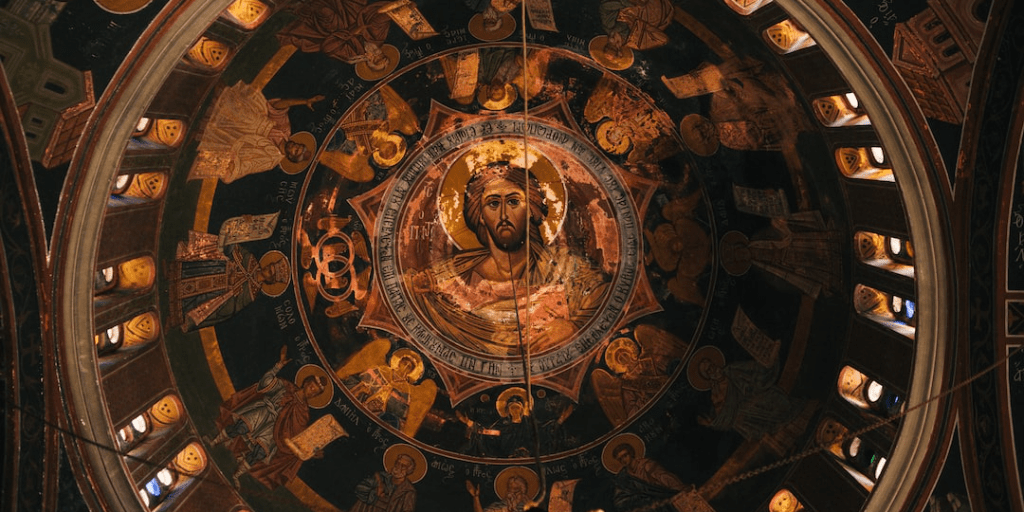
What makes Orthodoxy different?


I was recently asked to provide offer a quick overview of the beliefs and practices that make Eastern Orthodox Christianity different from the Western Christian confessions. This is no easy task; to get it done you need to paint with a pretty wide brush. With that said (and for what it’s worth) here’s my response…

To start off, it needs to be stressed that these are generalizations only. There are many different Western Christian confessions and Orthodoxy overlaps here and there with a lot of them. But the differences are significant and some of the big ones are as follows.

First, we understand salvation as being healed from a life-threatening wound, not getting a reprieve from a death sentence. The Church is a hospital, not a courtroom.

Second, becoming a Christian is not about making an intellectual agreement to a specific set of principles; it is about entering into a living relationship with Jesus Christ, through his Body on earth – the Church.

Third, there is more to reality than what we can see. The unseen world is real, it has an impact on us and we can impact it. And we connect with the unseen world through symbols, icons, and liturgy (ritual).

Finally (and I’ve saved the big one for last), we believe that heaven and hell are the same place. Actually, they are not places at all but reactions to, or experiences of, God’s Presence. At the end of this age everyone will be in the presence of God, some will like it and others won’t – that’s heaven and hell.

Again, these are only generalizations, but if they’ve piqued your curiosity at all, feel free to reach out and I’ll be happy to delve into them a little deeper with you.

Prayer and “vain repetition”


In his teaching on prayer in Matthew 6, is Jesus really condemning repetition in prayer? If so, why do we see multiple examples of repetitive prayer in the scriptures? Visions of heaven, in fact, show that around God’s heavenly throne all you hear is repetitive prayer: “Holy! Holy! Holy!”

Resisting Orthodoxy


Q: I want to draw closer to Eastern Orthodoxy but my spouse wants no part of it. What do I do?

A: These situations are more common than you might think. In fact, they are more the rule than the exception. Because this is an issue that touches directly on someone’s core values, you cannot push your spouse into a decision. Take your time and do your best to be a good witness to the Orthodox Faith, answering questions with kindness and accepting their resistance with patience. It’s a longer road, but one with much more fruitful possibilities for your family’s faith journey. And, of course, pray without ceasing that the Lord warms your spouse’s heart to the beauty and truth of Eastern Orthodoxy.

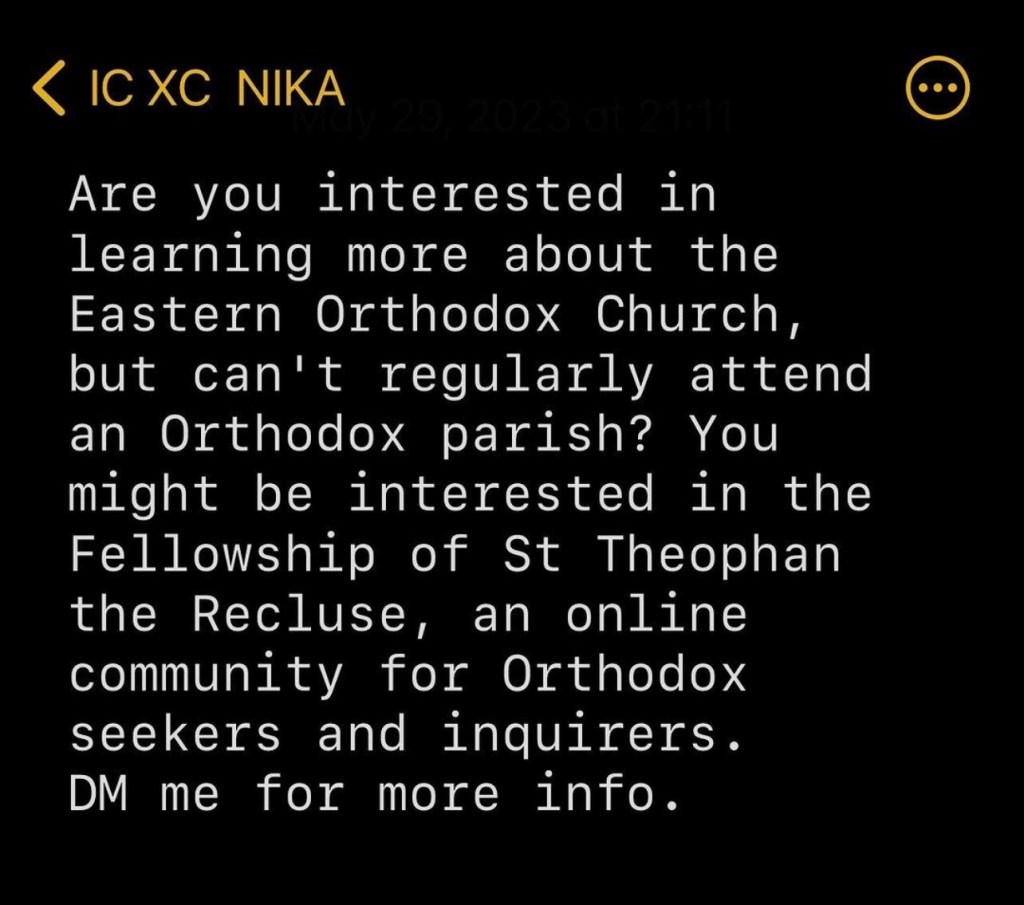
Online group for Orthodox seekers


The Fellowship of St Theophan the Recluse is a ministry of the Orthodox Church in America’s Bulgarian Diocese. We currently have over 100 members. Most members are from North America but we also have people from the British Isles, Latin America, Africa, and Australia.

It’s a mixed bag of interest levels. Some are very intentional about becoming Orthodox, but aren’t anywhere near an Orthodox church. Some would like to become more involved in the Orthodox Church, but cannot for a variety of reasons. Others are just checking Eastern Orthodoxy out.

We also have Orthodox Christians who can’t get to church regularly, or the church they attend has services and programs in a language they don’t understand.

All are welcome.

I send out an email every weekday to stay in touch and once a month we have a live meeting on Zoom.

If this sounds like something you might find helpful, send me an email for more info.

Why pray to the saints?


A question that I hear quite frequently concerns the intercession of the saints. Why do the Orthodox believe in this? Can you find references to it in the scriptures? I want to keep these posts short, so let me share with you a link to an episode of my podcast where I talk about this in a bit more detail.

First let me say this. The popular understanding of heaven and earth is that the dead are “up there” while we are “down here” and that there is largely no practical connection between the “up there” and the “down here.” Classical Christianity (ie, Eastern Orthodoxy), does not see the world in this way. The spiritual realm is a lot closer to us than we think, but our ability to perceive it is impaired.

So with that said, here’s the link.

https://anchor.fm/frajarmus/episodes/The-intercession-of-the-saints-e204h4m