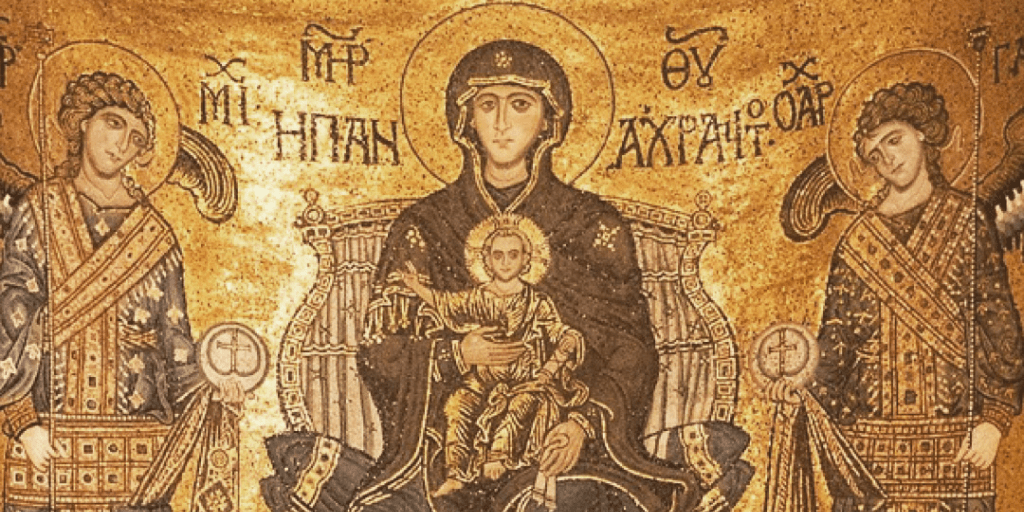
What they’re saying about Mary


Here are some more quotes on Mary from Church Fathers throughout the centuries:

“I have been amazed that some are utterly in doubt as to whether or not the holy Virgin is able to be called the Mother of God. For if our Lord Jesus Christ is God, how should the holy Virgin who bore him not be the Mother of God?” (St Cyril of Alexandria, 5th century)

“Though still a virgin she carried a child in her womb, and the handmaid and work of his wisdom became the Mother of God.” (St Ephraim the Syrian, 4th century)

“The first thing which kindles ardor in learning is the greatness of the teacher. What is greater than the Mother of God? What more glorious than she whom Glory Itself chose?” (St Ambrose of Milan, 4th century)

“For Luke, in the inspired Gospel narratives, delivers a testimony not to Joseph only, but also to Mary, the Mother of God, and gives this account with reference to the very family and house of David.” (St Gregory the Wonderworker, 3rd century)

“And if the former (Eve) did disobey God, yet the latter (Mary) was persuaded to be obedient to God, in order that the Virgin Mary might become the advocate of the virgin Eve. And thus, as the human race fell into bondage to death by means of a virgin, so it is rescued by a virgin; virginal disobedience having been balanced in the opposite scale by virginal obedience.” (St Irenaeus of Lyons, 2nd century)

“Eve, who was a virgin, willingly brought forth the word of the serpent into the world. Mary, the Virgin, willingly brings forth the Word of God into the world.” (St Justin Martyr, 2nd century)

The ancient Christian Fathers with one voice honor Mary as the Virgin Mother of God, whose obedience to the will of the Father opens the doors of salvation for all. This understanding echoed through the centuries in Christianity, even in some most unexpected places. Consider the following:

“I firmly believe that Mary, according to the words of the Gospel, as a pure virgin brought forth for us the Son of God, and in childbirth and after childbirth forever remained a pure, intact virgin.” (Ulrich Zwingli)

“To this day we cannot enjoy the blessing brought to us in Christ without thinking at the same time of that which God gave as adornment and honor to Mary in willing her to be the mother of his only-begotten Son.” (John Calvin)

“She is rightly called not only the mother of the man, but also the Mother of God.” (Martin Luther)

Through the prayers of the Theotokos, may our Lord Jesus Christ have mercy on us.

Love in Christ,
+FrAJ

The Dormition of the Mother of God


“And Mary said,
‘My soul magnifies the Lord,
and my spirit rejoices in God my Savior,
for he has looked on the low estate of his servant.
For behold, from now on all generations
will call me blessed…'” (Luke 1:46-48)

On August 15, the Orthodox Church commemorates a feast called the Dormition – the Falling Asleep – of the Mother of God, honoring the day that she died and entered into glory with her Son.

“The feast of the Dormition is the sign, the guarantee, and the celebration that Mary’s fate is, the destiny of all those of ‘low estate’ whose souls magnify the Lord, whose spirits rejoice in God the Saviour, whose lives are totally dedicated to hearing and keeping the Word of God which is given to men in Mary’s child, the Saviour and Redeemer of the world.” (Fr. Thomas Hopko)

The very name of this feast tells us everything that we need to know about the Christian understanding of death – Dormition, a falling-asleep. In Greek the word is “koimesis,” and this is where we get the English word “cemetery” from. A cemetery is a place where the faithful rest in the hope of the resurrection.

We need to be mindful of death, but we do not need to fear it. We simply need to prepare for that moment when we will go on to be with our Lord. Our hope and prayer is that, like Jesus’ most-holy Mother, at that moment each of us will find rest from the struggles of living a godly life in this world, and that we will rise in glory in the age to come.

Love in Christ,
+FrAJ

Mary ― Mother, Ever-Virgin


“…the Creator of all things incorporated with Himself a rational soul and a sensible body from the all-holy Mary, ever-virgin…” (St. Hippolytus of Rome, 3rd century)

“Let those, therefore, who deny that the Son is by nature from the Father and proper to his essence deny also that he took true human flesh from the ever-virgin Mary.” (St Athanasius the Great, 4th century)

“…the Word himself, coming into the Blessed Virgin herself, assumed for himself his own temple from the substance of the Virgin and came forth from her a man in all that could be externally discerned, while interiorly he was true God. Therefore he kept his Mother a virgin even after her childbearing.” (St Cyril of Alexandria, 5th century)

It is the consistent witness of ancient Christian writers that Mary remained a virgin her entire life. The usual first response to this statement is, “What about Jesus’ brothers mentioned in the Gospels?”

The use of the term “brothers” in the Gospels is inconclusive evidence that she had other children because that word was used to refer to any kindred of one’s own generation. This is still the case in many cultures today. While “brothers” could mean biological brothers, it could also mean stepbrothers or even cousins. This can also cross generations as in Genesis 14, where Abram’s nephew Lot is referred to as his brother (v.14).

In the Gospel of John, we read in the crucifixion narrative that Jesus entrusts Mary to the care of the Apostle John. If she had other children, this would have been unnecessary. It would have been the responsibility of one of her other children to take her in. After the death of her son, Mary would have been alone had she not been committed to the care of John and his family.

There’s something even more important at play here that we need to appreciate in order to fully understand why the Church taught Mary’s ever-virginity. In Jewish piety, someone who had been touched by the Holy Spirit was committed to a life of celibacy afterwards. For example, Moses’ sister Miriam was a prophetess and therefore celibate. In his commentary on the Gospel of Matthew, Fr. Lawrence Farley offers another example:

“Jewish midrash (or Bible commentary) from that time, speaking about Eldad and Medad (who received the Holy Spirit in power; see Num. 11:26), lamented, ‘How sad for the wives of those men! because such closeness to God meant they were now pledged to celibacy.”

The Gospel of Luke is very intentional about stressing that Mary’s Child is conceived by the Holy Spirit. This had an ongoing implication in her life. Just like the ancient Ark of the Covenant could not be touched by human hands, Mary, the living Ark of God, was also conjugally untouchable. To a pious Jew like Jospeh, this would have been clear from the moment he heard the words of the angel:

“Joseph, son of David, do not fear to take Mary as your wife, for that which is conceived in her is from the Holy Spirit.” (Matthew 1:20)

_

Interested in helping keep my ministry going and growing?
https:// http://www.buymeacoffee.com/frajarmus ☕️
Many thanks for your support! Prayers and blessings 🙏 ☦️