“I give you no formulas, says the Way, I give you no equations… Seek no formula. Seek no equation. Only be patient…” -“Christ the Eternal Tao”
Seek first the Kingdom
In the Sermon on the Mount, Jesus offers us teaching on how we should look at our lives. Some things in the scriptures are really difficult to understand but this particular teaching is so direct that you just look at it once and it’s obvious. It’s not easy, but it’s very clear.
The Dormition of the Mother of God

“And Mary said,
‘My soul magnifies the Lord,
and my spirit rejoices in God my Savior,
for he has looked on the low estate of his servant.
For behold, from now on all generations
will call me blessed…'” (Luke 1:46-48)
On August 15, the Orthodox Church commemorates a feast called the Dormition – the Falling Asleep – of the Mother of God, honoring the day that she died and entered into glory with her Son.
“The feast of the Dormition is the sign, the guarantee, and the celebration that Mary’s fate is, the destiny of all those of ‘low estate’ whose souls magnify the Lord, whose spirits rejoice in God the Saviour, whose lives are totally dedicated to hearing and keeping the Word of God which is given to men in Mary’s child, the Saviour and Redeemer of the world.” (Fr. Thomas Hopko)
The very name of this feast tells us everything that we need to know about the Christian understanding of death – Dormition, a falling-asleep. In Greek the word is “koimesis,” and this is where we get the English word “cemetery” from. A cemetery is a place where the faithful rest in the hope of the resurrection.
We need to be mindful of death, but we do not need to fear it. We simply need to prepare for that moment when we will go on to be with our Lord. Our hope and prayer is that, like Jesus’ most-holy Mother, at that moment each of us will find rest from the struggles of living a godly life in this world, and that we will rise in glory in the age to come.
Love in Christ,
+FrAJ
Seek first the Kingdom
In the Sermon on the Mount, Jesus offers us teaching on how we should look at our lives. Some things in the scriptures are really difficult to understand but this particular teaching is so direct that you just look at it once and it’s obvious. It’s not easy, but it’s very clear.
–
Interested in helping to keep my ministry going and growing? → https:// www.buymeacoffee.com/frajarmus
Many thanks for your support! Prayers and blessings 🙏 ☦️
Mary ― Mother, Ever-Virgin

“…the Creator of all things incorporated with Himself a rational soul and a sensible body from the all-holy Mary, ever-virgin…” (St. Hippolytus of Rome, 3rd century)
“Let those, therefore, who deny that the Son is by nature from the Father and proper to his essence deny also that he took true human flesh from the ever-virgin Mary.” (St Athanasius the Great, 4th century)
“…the Word himself, coming into the Blessed Virgin herself, assumed for himself his own temple from the substance of the Virgin and came forth from her a man in all that could be externally discerned, while interiorly he was true God. Therefore he kept his Mother a virgin even after her childbearing.” (St Cyril of Alexandria, 5th century)
It is the consistent witness of ancient Christian writers that Mary remained a virgin her entire life. The usual first response to this statement is, “What about Jesus’ brothers mentioned in the Gospels?”
The use of the term “brothers” in the Gospels is inconclusive evidence that she had other children because that word was used to refer to any kindred of one’s own generation. This is still the case in many cultures today. While “brothers” could mean biological brothers, it could also mean stepbrothers or even cousins. This can also cross generations as in Genesis 14, where Abram’s nephew Lot is referred to as his brother (v.14).
In the Gospel of John, we read in the crucifixion narrative that Jesus entrusts Mary to the care of the Apostle John. If she had other children, this would have been unnecessary. It would have been the responsibility of one of her other children to take her in. After the death of her son, Mary would have been alone had she not been committed to the care of John and his family.
There’s something even more important at play here that we need to appreciate in order to fully understand why the Church taught Mary’s ever-virginity. In Jewish piety, someone who had been touched by the Holy Spirit was committed to a life of celibacy afterwards. For example, Moses’ sister Miriam was a prophetess and therefore celibate. In his commentary on the Gospel of Matthew, Fr. Lawrence Farley offers another example:
“Jewish midrash (or Bible commentary) from that time, speaking about Eldad and Medad (who received the Holy Spirit in power; see Num. 11:26), lamented, ‘How sad for the wives of those men!‘ because such closeness to God meant they were now pledged to celibacy.”
The Gospel of Luke is very intentional about stressing that Mary’s Child is conceived by the Holy Spirit. This had an ongoing implication in her life. Just like the ancient Ark of the Covenant could not be touched by human hands, Mary, the living Ark of God, was also conjugally untouchable. To a pious Jew like Jospeh, this would have been clear from the moment he heard the words of the angel:
“Joseph, son of David, do not fear to take Mary as your wife, for that which is conceived in her is from the Holy Spirit.” (Matthew 1:20)
_
Interested in helping keep my ministry going and growing?
https:// http://www.buymeacoffee.com/frajarmus ☕️
Many thanks for your support! Prayers and blessings 🙏 ☦️
Holiness and the importance of place
“Someone asked Abba Anthony, ‘What must one do in order to please God?’ The old man replied, ‘Pay attention to what I tell you: whoever you may be, always have God before your eyes; whatever you do, do it according to the testimony of the holy Scriptures; in whatever place you live, do not easily leave it. Keep these three precepts and you will be saved.’” (Sayings of the Desert Fathers)
An important (but lesser-known) quality necessary for spiritual healing and growth is geographic stability. God calls un to be his disciples in specific places.
_
Interested in helping to keep my ministry going and growing?
→ https:// http://www.buymeacoffee.com/frajarmus ☕️
Many thanks for your support! Prayers and blessings 🙏 ☦️
A choice to love and trust
The Two Great Commandments are not: Agree to this set precepts about God; and agree to that set precepts about your neighbor. Faith is not about intellectual assent; faith is about love. Faith is our loving, trusting response to the love of God for us. And in our loving response to God’s love a life-giving relationship is forged. My sermon at St. Nicholas Orthodox Cathedral in Fort Wayne, Indiana, on Sunday, July 9, 2023.
_
Interested in helping keep my ministry going and growing?
→ https:// http://www.buymeacoffee.com/frajarmus ☕️
Many thanks for your support! Prayers and blessings 🙏 ☦️
The Story of Our Salvation (or “My Visit to Zootown”)
In June 2022, I was invited to speak on Eastern Orthodox Christianity at Zootown Church in Missoula, Montana. I talked with with my bishop, and he agreed that it was an opportunity I couldn’t pass up. It was a wonderful visit. I met some very devout and kind hearted believers, and I made some new friends. The theme of my message was how the ancient Christian Church understands the story of our salvation.
“Glory to God for All Things!”
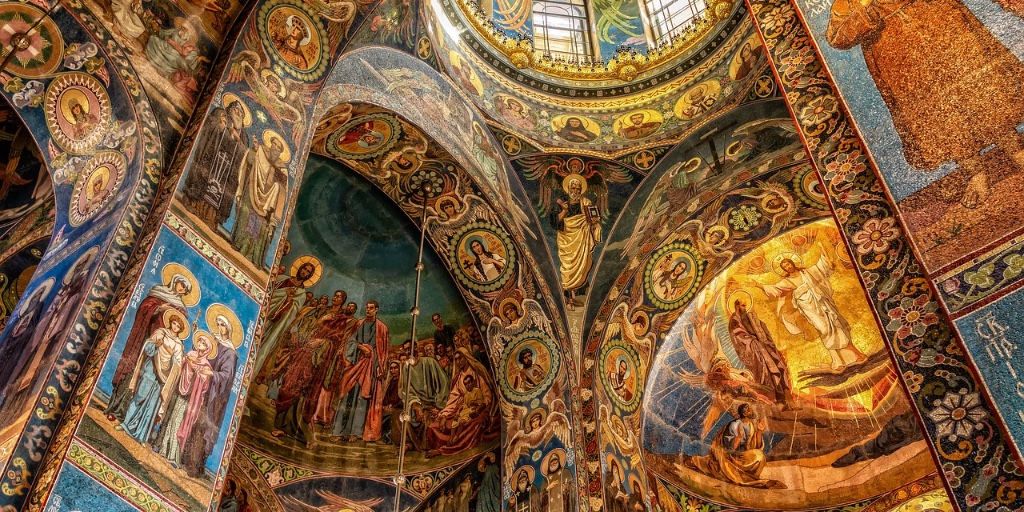
An Akathist Prayer is sacred poetry, consisting of thirteen segments. The word “akathist” means “without sitting,” indicating that these prayers are meant to be recited standing up.
The earliest and best known Akathist is to the Mother of God. A contemporary Akathist that has captured the hearts of Orthodox faithful throughout the world is the Akathist of Thanksgiving, also known as “Glory to God for All Things” (St. John Chrysostom’s final words.
The Akathist of Thanksgiving is the 20th-century composition of a Russian Orthodox bishop, Metropolitan Tryphon (Turkestanov) who died in 1934. A copy of the text was found on the body of Father Gregory Petrov after his death in a Soviet prison camp. In the midst of that man-made hell, Fr. Gregory found solace in the words of this hymn.
Here’s a link to the Akathist of Thanksgiving on my church’s website. I pray that these words fill your heart with comfort and encouragement.
Love in Christ,
+FrAJ
Why the Incarnation?
A look at how the Eastern Orthodox Church understands why the Son of God had to become human and what his incarnation did for us.
 Eastern Orthodoxy