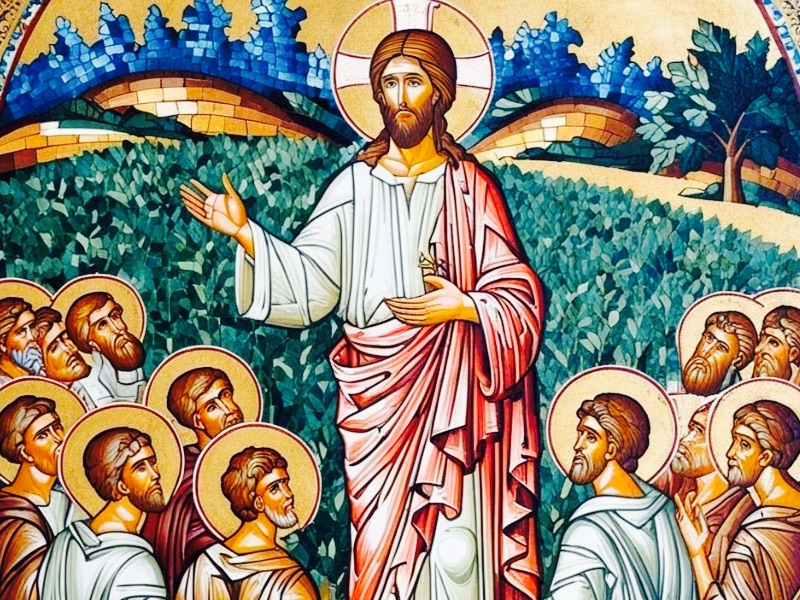
The Word Creates

The opening of Genesis and John shows that the world is made by God’s Word. Genesis 1 depicts God speaking the universe into existence: God does not build or struggle with raw materials; he simply speaks, and the Cosmos comes into being. Creation itself is a kind of liturgy, ordered and sustained by the living Word of God.

This shapes how we understand both the world and Jesus Christ. When Scripture says that God creates by speaking, it teaches that his Word is not just information but life‑giving power. God’s speech is supremely effective; it accomplishes what it declares. Every creature exists because it has been personally addressed by God.

The Gospel of John then makes this personal Word explicit: “In the beginning was the Word, and the Word was with God, and the Word was God.” Before anything was made, the Word already is, in perfect communion with the Father and truly God. “All things were made through him” means that the same divine Word who speaks in Genesis is the eternal Son, the one through whom all things came to be.

Creation is therefore Trinitarian: the Father creates through the Son in the Holy Spirit. The order and beauty of the world reflect the wisdom of the Word, the signature of Christ on everything that exists. The One who will later walk the roads of Galilee is the same One through whom galaxies, oceans, and atoms were brought into being.

The Holy Evangelist John then makes a staggering claim: “The Word became flesh and dwelt among us.” The eternal Word who called light out of darkness enters the very world he made, taking on our nature without ceasing to be who he is eternally. The hands that shaped the stars become the hands of a carpenter and are later stretched out on the Cross. The voice that said “Let there be light” will cry, “It is finished,” bringing about a new creation.

To say that Jesus Christ is the Word of God is to say that the Savior of the world is also its Maker. In him, the first creation and the new creation meet. He still speaks, calling each of us out of darkness into his light, and when he speaks, things change: the Word who once created now re‑creates, restoring in us the image first spoken into being at the dawn of this age.

Standing Fast in Christ

In his first epistle to the Corinthians, the Holy Apostle Paul offers the faithful these words of wisdom: “Watch, stand fast in the faith, be brave, be strong. Let all that you do be done with love.” (1 Cor. 16:13-14) From the very beginning, Christians have needed this encouragement.

There are always temptations either to compromise the faith or to give it up entirely. Yet standing fast in Christ does not mean being harsh or argumentative. Paul reminds us: everything must be done in love. Too often (especially online!), defending the faith looks like winning arguments or scoring “gotchas.” But in truth, no one has ever been argued into the Kingdom by clever comebacks.

Our calling is the same as that of the believers in Corinth who first heard St. Paul’s words: to witness through compassion, patience, and kindness—even when others take aim at us. Christ did not conquer by force or arrogance, but by emptying Himself in love on the Cross.

To stand fast in the faith means keeping our integrity, being brave to love when it’s hardest, and being strong enough not to sink into bitterness. The Kingdom is built on peace, kindness, and love, and as St. Paul urges, “Let all that you do be done in love.”

Our Father


Much has been written about the Lord’s Prayer and you can find hours and hours of podcast episodes on it. It’s worth taking the time to look these sources up (this lecture by Fr. Thomas Hopko is a great place to start).

St. John Chrysostom said:

The Lord teaches to make our prayer common, in behalf of our brethren also. Because he does not say: “My Father, in Heaven,” but, “Our Father,” offering up his supplications for the body in common, and in no way only looking out for his own good, but looking out in all things for his neighbor’s good. And by this he at once takes away hatred, and quells pride, and casts out envy, and he brings in selfless love – the mother of all good things, and exterminates the inequality of human things…

What St. John is pointing out is that we don’t say, “My Father,” we say, “Our Father.” The Lord’s Prayer is the great equalizer in Christianity. Regardless of our race or cultural heritage, of our station in life, or of any other demographic into which we can be separated, we are all united in calling God: Our Father.

An ancient Christian saying states that “One Christian is no Christian.” Christianity is relational at its core. The word for Church in the New Testament, “ecclesia,” literally means a people called together. This is how the Lord Jesus Christ defines his people: as one Body, united by his grace.

In my journey through life, I don’t walk alone. I walk together with all of my brothers and sisters, untied through Christ as a family of faith, children of Our Father in heaven. 

Seek first the Kingdom


In the Sermon on the Mount, Jesus offers us teaching on how we should look at our lives. Some things in the scriptures are really difficult to understand but this particular teaching is so direct that you just look at it once and it’s obvious. It’s not easy, but it’s very clear.

Interested in helping to keep my ministry going and growing? → https:// www.buymeacoffee.com/frajarmus

Many thanks for your support! Prayers and blessings 🙏 ☦️

The Story of Our Salvation (or “My Visit to Zootown”)


In June 2022, I was invited to speak on Eastern Orthodox Christianity at Zootown Church in Missoula, Montana. I talked with with my bishop, and he agreed that it was an opportunity I couldn’t pass up. It was a wonderful visit. I met some very devout and kind hearted believers, and I made some new friends. The theme of my message was how the ancient Christian Church understands the story of our salvation.