Explaining the Divine Liturgy (Part 1)


Here’s the first half of a discussion on the Eastern Orthodox Divine Liturgy. I structured it around an early second century description of a Christian Eucharistic service, written by St. Justin the Martyr:

  • “On the day called Sunday, all gather together to one place…
  • “And the memoirs of the apostles or the writings of the prophets are read…”
  • “Then the president verbally exhorts to the imitation of these good things…”
  • “Then we all rise together and pray…”
  • “Bread and wine and water are brought forth…
  • “The president offers prayers and thanksgivings… and the people give their ascent, saying: Amen…”
  • “There is a distribution to each of that over which thanks has been given…”
  • “And they who are well to do give what each thinks fit to take care of all who are in need.”

__

Help keep my ministry going and growing… Buy me a coffee → https://www.buymeacoffee.com/frajarmus ☕️

Many thanks for your support! Prayers & Blessings 🙏 ☦️
“Let my pray arise as incense…”


In the Eastern Orthodox Church, the use of incense in worship and personal prayer holds profound symbolism. There are two significant meanings attached to the fragrant smoke that fills our sacred spaces.

First, incense symbolizes is our prayers rising to heaven, as we read in Revelation 8: “And another angel came and stood at the altar with a golden censer, and he was given much incense to offer with the prayers of all the saints on the golden altar before the throne…” We also find this petition in Psalm 141: “Let my prayer be counted as incense before you, and the lifting up of my hands as the evening sacrifice!”

The other symbolic meaning of incense has to do with the Temple in Jerusalem. On the Day of Atonement, when the High Priest entered the Holy of Holies, he would carry a bowl filled with much incense. The smoke served as a filter to protect him from the Divine Glory sitting on the mercy seat. In II Chronicles 5 we read that the priests couldn’t serve in the Temple when the Lord’s Glory descended upon it. And in Isaiah 6, when the prophet is given a vision of the heavenly Temple, he says “the house was filled with smoke.” Incense, then, also indicates our entrance into the Presence of God when we gather for worship.

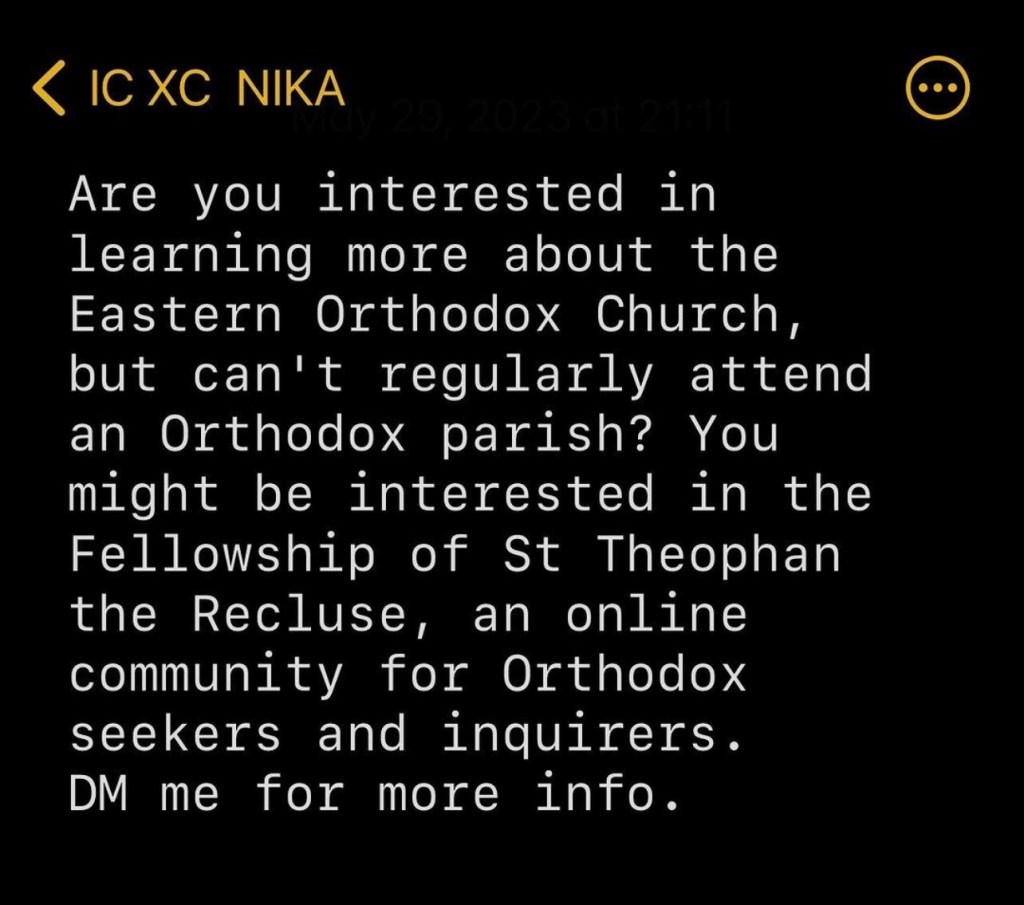
Online group for Orthodox seekers


The Fellowship of St Theophan the Recluse is a ministry of the Orthodox Church in America’s Bulgarian Diocese. We currently have over 100 members. Most members are from North America but we also have people from the British Isles, Latin America, Africa, and Australia.

It’s a mixed bag of interest levels. Some are very intentional about becoming Orthodox, but aren’t anywhere near an Orthodox church. Some would like to become more involved in the Orthodox Church, but cannot for a variety of reasons. Others are just checking Eastern Orthodoxy out.

We also have Orthodox Christians who can’t get to church regularly, or the church they attend has services and programs in a language they don’t understand.

All are welcome.

I send out an email every weekday to stay in touch and once a month we have a live meeting on Zoom.

If this sounds like something you might find helpful, send me an email for more info.

Press on in Faith


After Christ’s death the Myrrh-bearing Women, Jospeh of Arimathea, and Nicodemus press on to serve their Lord, no mater what. My sermon on the Sunday of the Myrrh-bearing Women, April 30, 2023.

What do we need to confess?

The holy Mystery of Repentance (Confession) is a time to stand before Christ, the great Physician of our souls, to be healed of the sins that plague us. But what type of sins do we need to bring to confession? Here are a couple of tips that I share with my parishioners.